Many Muslims struggle to remember Dua e Qunoot, especially when they are learning Witr prayer. Maybe you recently started praying regularly. Maybe you want to memorize the dua properly.
Many people search for a simple Dua e Qunoot in Roman English version so they can memorize it step-by-step.
In this guide, you will learn Dua e Qunoot in English transliteration, when to recite it, the benefits of this dua, a powerful Hadith about protection, and Common questions Muslims ask.
Make sure you read the full article and try to memorize 2 to 3 lines every day. Within a week, Insha’Allah, you will remember it completely.
Dua e Qunoot in Roman English
Qunoot Dua is a powerful supplication recited in the Witr prayer after Isha. You do not have to panic if you haven’t memorized it yet. Many Muslims learn it slowly.
Follow these steps:
- Read it daily.
- Memorize 2 to 3 lines at a time.
Here is the complete Dua e Qunoot in English, which was reported in As-Sunan Kubra lil-Bayhaqi 2/201 and Musannaf Ibn Abi Shaybah Volume 2, Hadith 7023–7025 (according to Hanafi).
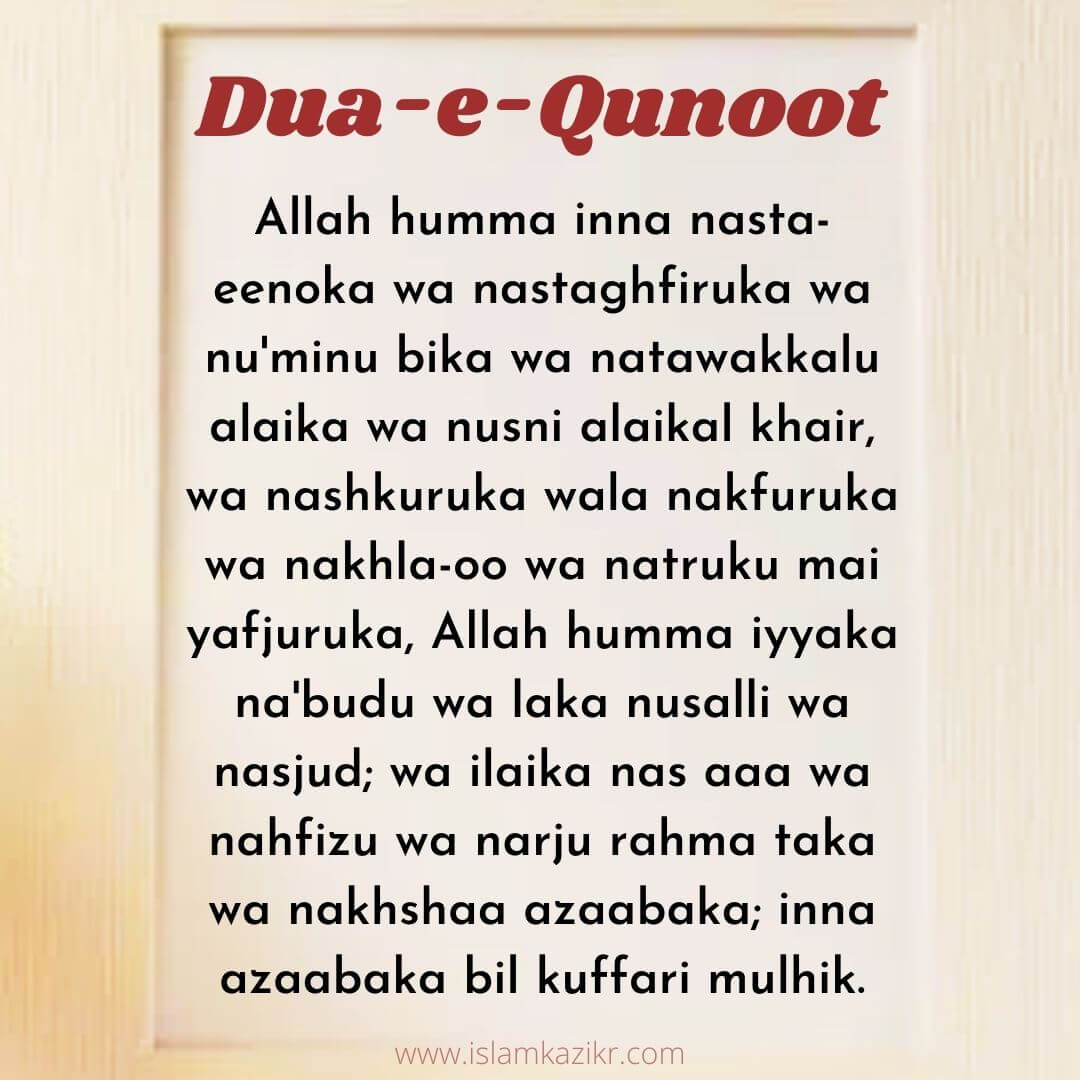
Try to practice this daily. Within 5 to 7 days, most people memorize it easily.
The Dua below can also be read

Note: These images of Dua e Qunoot in Roman English Transliteration, i.e., English text, will be easier for you to download and memorize.
When to Recite
This is one of the most common questions Muslims ask. You need to recite Dua e Qunoot in the Witr prayer, which is prayed after Isha.
In most Hanafi practices, the dua is recited in the third rakah of Witr.
Follow these steps carefully:
- Pray the third rakah of Witr.
- After Surah recitation, say takbeer – Allahu Akbar.
- Raise your hands like the start of Salah.
- Recite Dua Qunoot.
- Continue with ruku.
Dua e Qunoot Meaning in English
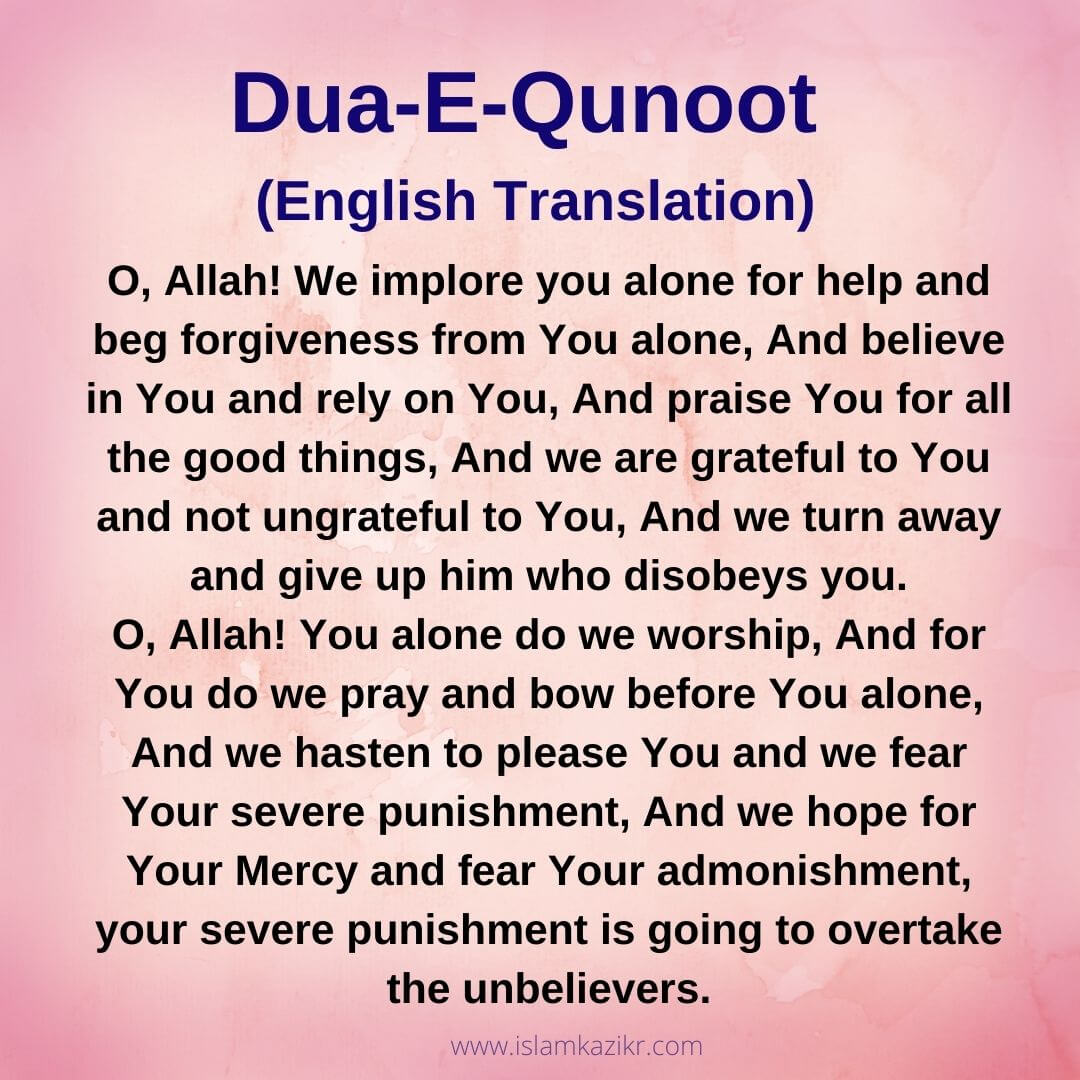
Find out the beautiful translation of the dua for Witr prayer from the image. You may download the meaning/translation of Dua e Qunoot in Roman English and save it to your device.
Benefits of Dua e Qunoot in English
Dua Qunoot is not just a recitation in prayer. It is a powerful supplication asking Allah for guidance, mercy, and protection.
When you understand the meaning, the prayer becomes more powerful.
Here are some important benefits:
1. Asking Allah for Guidance
The dua begins by asking Allah for help and forgiveness. This reminds you that true guidance comes only from Allah.
2. Strengthens Tawakkul
The dua says:
“Wa natawakkalu ‘alayk” — we believe in You.
This builds spiritual reliance on Allah.
3. Protection from Punishment
The dua also asks for protection from punishment. That is why many scholars say this dua contains both hope and fear of Allah.
4. Builds Humility in Prayer
When you recite Dua Qunoot slowly, it increases humility in Salah. Your heart becomes softer. And that is the real purpose of prayer.
Authentic Hadith About Dua e Qunoot
There are authentic narrations showing that the Prophet ﷺ recited Qunoot in prayer. In a hadith reported in Jami` at-Tirmidhi 464,
Al-Hasan bin Ali [may Allah be pleased with him] said:
“Allah’s Messenger taught me some phrases to say during Al-Witr (Allahummahdini fiman hadait, wa a’fini fiman afait, wa tawallani fiman tawallait, wa barik Li fima atait, wa qini sharra ma qadait, fa Innaka taqdi wa la yuqda Alaik, wa innahu la yadhillu man walait, tabarakta Rabbana wa ta’alait.) ‘O Allah guide me among those You have guided, pardon me among those You have pardoned, befriend me among those You have befriended, bless me in what You have granted, and save me from the evil that You decreed. Indeed You decree, and none can pass decree, and none can pass decree upon You, indeed he is not humiliated whom You have befriended, blessed are You our Lord and Exalted.'”
The following is the Dua Qunoot recited in Witr prayer according to the Hanafi school of thought. This supplication has been reported from companions such as Abdullah ibn Mas’ud (RA) and recorded in classical Hadith collections.
Allah humma inna nasta-eenoka wa nastaghfiruka wa nu’minu bika wa natawakkalu alaika wa nusni alaikal khair, wa nashkuruka wala nakfuruka wa nakhla-oo wa natruku mai yafjuruka, Allah humma iyyaka na’budu wa laka nusalli wa nasjud wa ilaika nas aaa wa nahfizu wa narju rahma taka wa nakhshaa azaabaka inna azaabaka bil kuffari mulhik
As-Sunan Kubra lil-Bayhaqi 2/201
Tips to Memorize Dua e Qunoot Faster
If you want to memorize the Dua quickly, follow these practical steps.
Step 1: Break It Into Small Parts.
Divide the dua into 3 sections. Memorize one section per day.
Step 2: Repeat After Salah
Recite it 3 to 5 times daily after prayer. Repetition builds memory.
Step 3: Listen to Recitations
Listening improves pronunciation. Many people memorize the dua within 7 days using this method.
Be consistent. Insha’Allah, you will succeed.
FAQs About Dua e Qunoot in English
1. What is Dua e Qunoot?
Qunoot Dua is a special supplication recited in the Witr prayer after Isha Salah. It is a dua where a believer asks Allah for help, forgiveness, mercy, and protection from punishment.
You need to recite it in the third rakah of Witr prayer.
You can also read our guide on the importance of Dua e Qunoot.
2. Is Dua e Qunoot mandatory in Witr prayer?
This depends on the school of thought. In the Hanafi madhab, Dua e Qunoot in Witr is considered Wajib. Other schools consider it Sunnah.
3. How long does it take to memorize this Dua?
Most beginners memorize it faster than they expect. Based on my experience teaching beginners, people usually memorize it in 5 to 7 days.
4. Can I read Qunoot Dua from a piece of paper or card?
Scholars have explained that there is nothing wrong with reading Dua e Qunoot from a piece of paper or a booklet during Witr prayer, until you memorize it.
5. Is Dua e Qunoot mentioned in the Qur’an?
No. It is the Sunnah of the Prophet Muhammad (Sallallahu Alaihi Wasallam).
6. Can this Dua be recited before or after Ruku?
According to classical Hadith sources, both methods are permissible.
Referenes
These are the main Hadith and scholarly sources related to Dua Qunoot and Witr prayer.
1. Sunan Abu Dawood – Hadith 1425 (Supplication in Witr prayer)
2. Jami’ at-Tirmidhi – Hadith 464 (Dua taught to Hasan ibn Ali for Qunoot)
3. Musannaf Ibn Abi Shaybah – Vol 2, Hadith 7023–7025 (Qunoot reported from companions)
4. As-Sunan Kubra lil-Bayhaqi 2/201 – Vol 2 (Narrations about Qunoot in Witr)
5. Fiqh al-Sunnah by Sayyid Sabiq – Chapter on Witr Prayer