Wa Tu Izzu Mantasha Watu Zillu Mantasha is a popular phrase from the Holy Qur’an. It is part of the 26th ayah of Surah Al-Imran:
Say, ˹O Prophet,˺ “O Allah! Lord over all authorities! You give authority to whoever You please and remove it from who You please; You honour whoever You please and disgrace who You please—all good is in Your Hands. Surely You ˹alone˺ are Most Capable of everything. – [Surah Al-Imran:26]
WaTu Izzu Mantasha Watu Zillu Mantasha Translation in English
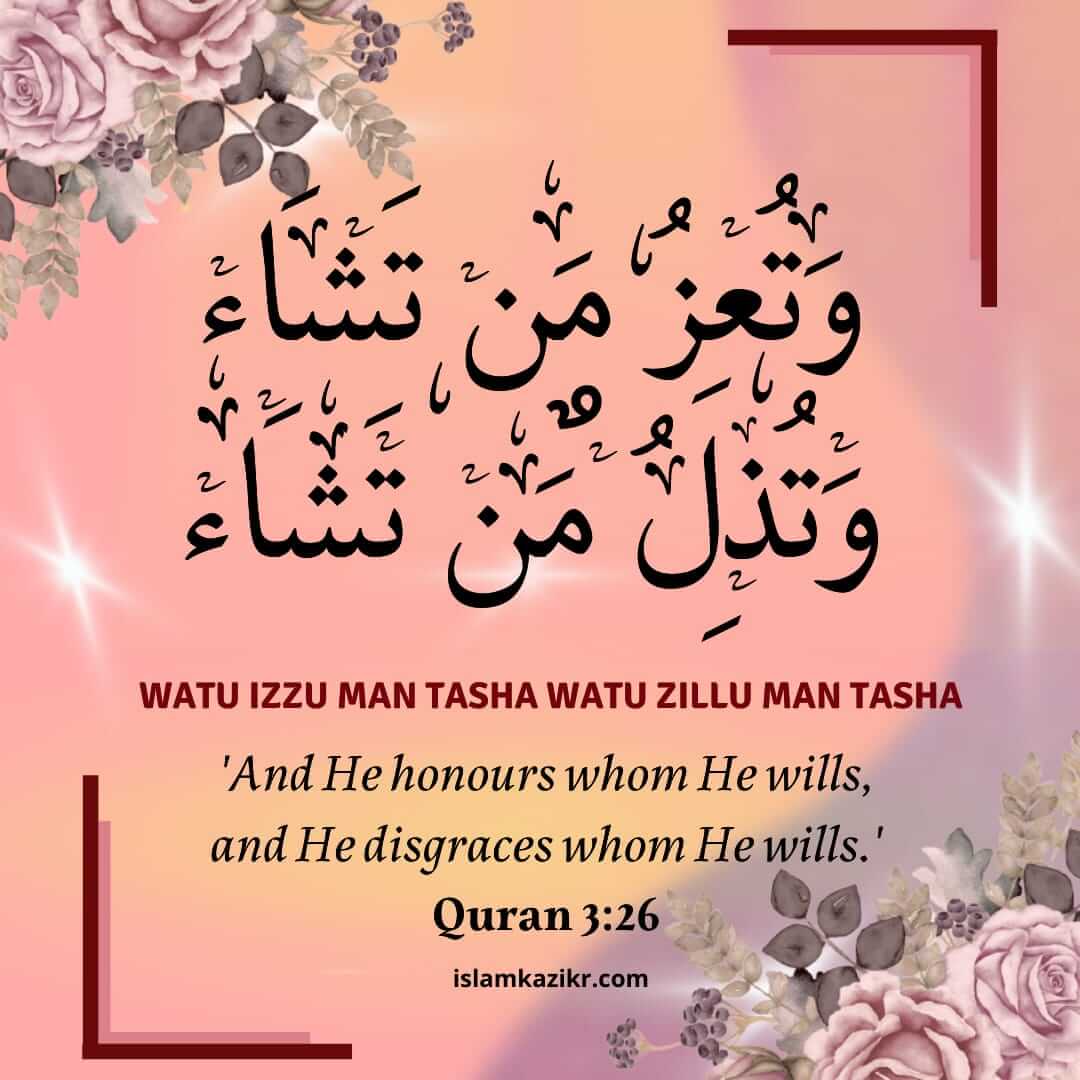
In Arabic, this Ayah is written as:
وَتُعِزُّ مَنۡ تَشَآءُ وَتُذِلُّ مَنۡ تَشَآءُ
The meaning of this Ayah in English is as follows:
‘And He honours whom He wills, and He disgraces whom He wills’.
English transliteration:
Wa Tu Izzu Mantasha Watu Zillu Mantasha
Meaning of Wa Tu Izzu Mantasha Watu Zillu Mantasha
Allah alone holds power over every Kingdom that ever existed. Be it that which He gave to a common man, Prophet David (PBUH), or be it that which He gave to the pharaoh. One used this kingdom to get closer to Allah SWT, to become more Humble, and to thank Him. The other used it to become arrogant, proud, and evil. But in the end, the kingdom still belonged to Allah SWT. He had the power to give to whoever He willed. The only choice any human has is to decide how to use this blessing.
Similarly, honor lies with Allah SWT. When He gives honor to someone, it could mean either a reward or a test. Honor could either be wealth, power, position, or respect in the eyes of others, or anything material, or, in case of a blessing or reward it would be the real honor in the eyes of the exalted, the Almighty Allah.
In any case, the first thing a person must do is to become thankful for it. Next, he should remember to use this power or position to get closer to Allah SWT. When Prophet David (PBUH) killed goliath he became more Humble. When Prophet Suleiman (PBUH) became a great king, he became more Humble when Prophet Muhammad (SAWS) got back control of Mecca, he became more Humble.
To become humble with power, wealth, or position is an act of noble people because these people know that real honor lies in Allah’s hand. He is the one who gave it, and he is the one they must be thankful to.
The next part of this ayah is the most dominant. It says all good is in Allah’s hand. And what is the real good? It’s Allah’s will. Whoever bows down and submits to this will be successful. Every hardship, pain, and suffering will not make him cry rather, he will understand that this is part of Allah’s plan. Allah is the best planner. He sometimes makes people stronger with pain and suffering and tests others with happiness and success. But the real intention lies with him. The honored ones are those who submit to his will.
Background Of The Ayah:
After the battle of Badr and Uhud, the mushrikeen were humiliated and hence terrified by the rising power of the Prophet (PBUH) and his followers. To end this early, they united with the Jews and Christians and plotted a big battle against Muslims. The mind behind this collaboration was Hoyai Ibn Al-Akhatb, the head of Bani An-Nadir, the Jewish tribe that broke its oath with the Prophet (S.A.W.) and was consequently driven out of Madinah. This was the battle of Ahzab (parties).
The news of this large army was broken only 15 days before the battle. Prophet Muhammad (PBUH) was looking for a strategy with his companions when one of the companions, Sulayman Al- Farsi suggested digging a trench to block the disbelievers’ army. He was a Persian man, and this was a common war tactic in his homeland.
For this reason, this battle is also called the Battle of trench. This idea was the most suitable one in the given situation.
The land of Madinah was surrounded by pointy rocky land on the east, west, and south, which one can cross. So the ditch was planned to be dug on the north side of the city. But this wasn’t an easy task, given that the inhabitants were already fighting poverty and starvation. The Prophet (PBUH) and his companions worked day and night on this mission, and then came a point when the companions reached a rock too heavy and large to be broken into pieces.
When they almost gave up, the Prophet (PBUH) himself came forward with a pickaxe and struck the rock. He struck it thrice, and each time a light appeared that illuminated far places. He said these are places of Yemen, Syria, and Rome that Muslims will soon conquer.
When the news of this glad tidings reached the hypocrites of Madinah, they laughed and ridiculed Muslims that how can people so weak conquer so many places. Then this Ayah was revealed.
Tafseer Of Wa Tu Izzu Mantasha Watu Zillu Mantasha:
According to Ibn-e-Kaseer, this ayah means praising, thanking, relying on Allah SWT in matters, and trusting Him alone.
Wa Tu Izzu Mantasha Watu Zillu Mantasha means Allah is the one who gives honor and he is the one who takes it away. Honor is a noble blessing of Allah SWT, and He is the owner of it. The one who is blessed with it must know that he needs to thank Allah SWT for it.
Such a person must be a Shakir (the one who thanks). Kingdoms, wealth, honor, power, and knowledge keep moving from one human to another. None can claim possession of it forever. Only Allah SWT is the owner and giver of it. A person who receives it will either be thanked for it, use it appropriately and then benefit in the hereafter from it, or if he chooses to misuse it, or become arrogant with possession of it will be one day disgraced by Allah.
The real honor of a human always lies in choosing and being on the right path. Every single time we choose to do good or keep away from bad, we must know Allah SWT has honored us.
Benefits & Lessons From This Ayah:
- This is the ayah of hope. However weak one may seem to be, the real giver of power is Allah SWT, and one must always trust that He can change the fate and situation of His believers. The only thing is to be steadfast on the path of Allah SWT and keep working on becoming a better and of Allah SWT (slave of Allah).
- Say Alhamdulillah and be thankful for what Allah SWT has honored you with, and try to use it for the benefit of the ummah and yourself.
- When one is in calamity or is humiliated, then he must read this ayah to reassure himself that Allah can ease his situation and bring victory to him. He must know that none can dishonor him except Allah SWT.
- The one who fears poverty, debt, calamity, or being disgraced by people must remember this ayah and supplicate to Allah, the owner of all wealth and every treasure.
FAQs
1. What does Wa Tu Izzu Mantasha mean?
It means “You give honour to whom You will.” It refers to Allah granting dignity, status, or authority.
2. What does Watu Zillu Mantasha mean?
It means “And You humiliate whom You will.” It highlights Allah’s power to lower someone’s status.
3. Which Surah contains this phrase?
The phrase appears in Surah Aal-Imran (3:26) in the Quran.
4. Why do Muslims recite this verse?
Muslims recite it in duas asking Allah for honour, success, and protection from humiliation.
Authentic References
Here are the authentic sources for this phrase:
- The Quran – Surah Aal-Imran (3:26)
- Tafsir Ibn Kathir – Explanation of Surah 3:26
- Tafsir Al-Tabari – Commentary on Allah’s sovereignty